
TOYS / EVERETT · Homegrown fun
Big Heads, Local Roots: Funko Before and Beyond Pop!
The Northwest company began with remembered characters, strange little figures, and people who wanted to keep them.
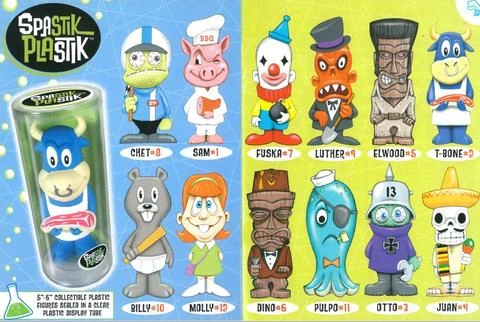
Start with the beaver in the old character lineup. He is an odd little object, holding a piece of wood and wearing gold-colored underpants. Place him beside the square-headed figures now associated with Funko and the family resemblance is not obvious. That makes him a good place to begin. The company’s history contains a much stranger shelf than a row of matching Pop! boxes might suggest.
Funko traces its business to 1998 and nostalgic bobblehead figures. Founder Mike Becker began at his home north of Seattle with a tribute to the Big Boy restaurant mascot. An Austin Powers figure became an early success. Remembered advertising and screen characters were already supplying the essential invitation: here is something you recognize, made small enough to keep.
Recognition, with a moving head
A bobblehead asks very little of its owner. It does not need batteries, a cartridge or a television. A touch supplies the action. The pleasure starts with recognition and continues with an almost unnecessary motion: a familiar face nodding on a shelf. That is a different kind of play from the console stories elsewhere in this issue, but it belongs to the same world of attachments.
Becker’s later reflections on collecting connect the object to the time it recalls. A character can stand for a cartoon watched with a sibling or the feeling of an ordinary morning. The attraction extends beyond owning a likeness. For a collector, the figure can give a memory a place among the things that remain visible every day.
That reading helps explain why a company could grow around older mascots rather than only the newest entertainment property. An advertising character already arrives with a history in someone else’s life. Recasting it as a small object lets the owner choose where that history will live next.
A very strange little family
Fantastik Plastik began in 2003. In Funko’s later account, designer Rob Schwartz and art director Sean Wilkinson describe a creative atmosphere shaped by hot rods, tiki imagery, advertising icons and the creators’ own jokes. Billy the Beaver belongs to that early world. Packaging and the relationships with devoted fans were part of its character, too.
The sculpting has a particular charm: an improbable personality compressed into a small, self-contained silhouette. You can read the attitude before you know the character’s name. It is a reminder that early Funko was experimenting with its own strange figures as well as with licensed faces.
A 2005 acquisition changed the scale of the ambition. Funko’s 2017 prospectus records a small investor group led by Brian Mariotti taking over the company. Under his leadership, the business broadened its relationships with entertainment property owners and expanded the kinds of products it offered.
The head becomes a language
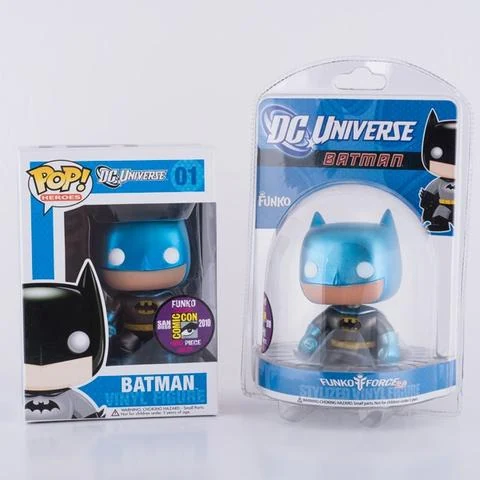
The Batman photograph catches a useful transition. On one side is the now-familiar rectangular package; on the other is a clear dome. Funko’s archive identifies the early dome-packaged Blue Batman with San Diego Comic-Con in 2010. The image lets us look at a recognizable form before its packaging had become the standard sight on so many shelves.
The large head and reduced body create room for a few identifying details. A mask, hairstyle, piece of clothing or accessory has to do much of the work. Put figures from unrelated stories beside one another and their shared proportions make them look like members of a collection. The format supplies a visual connection that the original stories never needed to share.
It also changes how a collection can be arranged. A shelf can follow one fictional universe, one actor’s roles, a favorite era, or simply the owner’s taste. The pleasure lies partly in deciding which associations deserve a space. The figure is a small representation; the arrangement is personal.
Everett puts the shelf on the street
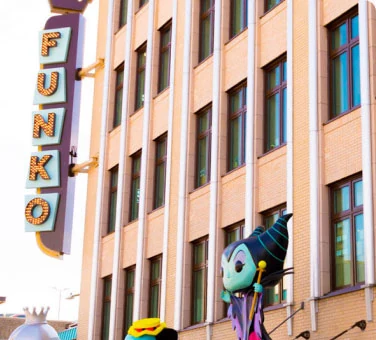
On August 19, 2017, Funko opened its headquarters store in downtown Everett at 2802 Wetmore Avenue. The advance announcement promised themed spaces, activities, photo opportunities and exclusive items, with a signing by Mariotti. It brought the company’s collecting world into a public-facing local space.
A shop like this gives fandom a physical setting. Oversized characters and themed displays change the scale of the objects: the figures usually held in a hand become a world someone can walk through. For this issue, the storefront also makes the regional connection legible. Everett is a place on the map, as well as an address on a company document.
That same year, Funko’s prospectus described a business built around licensed pop-culture products and a wide network of retail customers. The small novelty company had become a much larger organization. Growth changed its range and reach, while the basic transaction remained recognizable: choose a character that means something to you and take it home.
Keep the odd ones in the picture
The early figures prevent the history from becoming too tidy. Billy the Beaver does not look like an inevitable stepping stone to a global collectible format. He looks like somebody had an idea they found funny, and wanted to see it made. There is value in leaving that uncertainty in the story.
Funko’s Northwest history connects homegrown enthusiasm with a business that eventually traveled far beyond the region. The characters came from many places; the collectors brought their own memories. The local company gave those attachments a succession of physical forms, from bobbling heads and peculiar little creatures to a recognizable family of figures.
Return to the beaver at the beginning and the shelf becomes more interesting. There is room on it for a company’s early humor, a collector’s first convention, and an object bought because it recalled a television morning. The history of Funko belongs in all three places, with Everett as one of its visible local homes.