
TOYS & BUILDING · Wish big
A Galaxy on the Carpet: The Promise of LEGO Space
Blue bricks, yellow windows, and somewhere new to go.
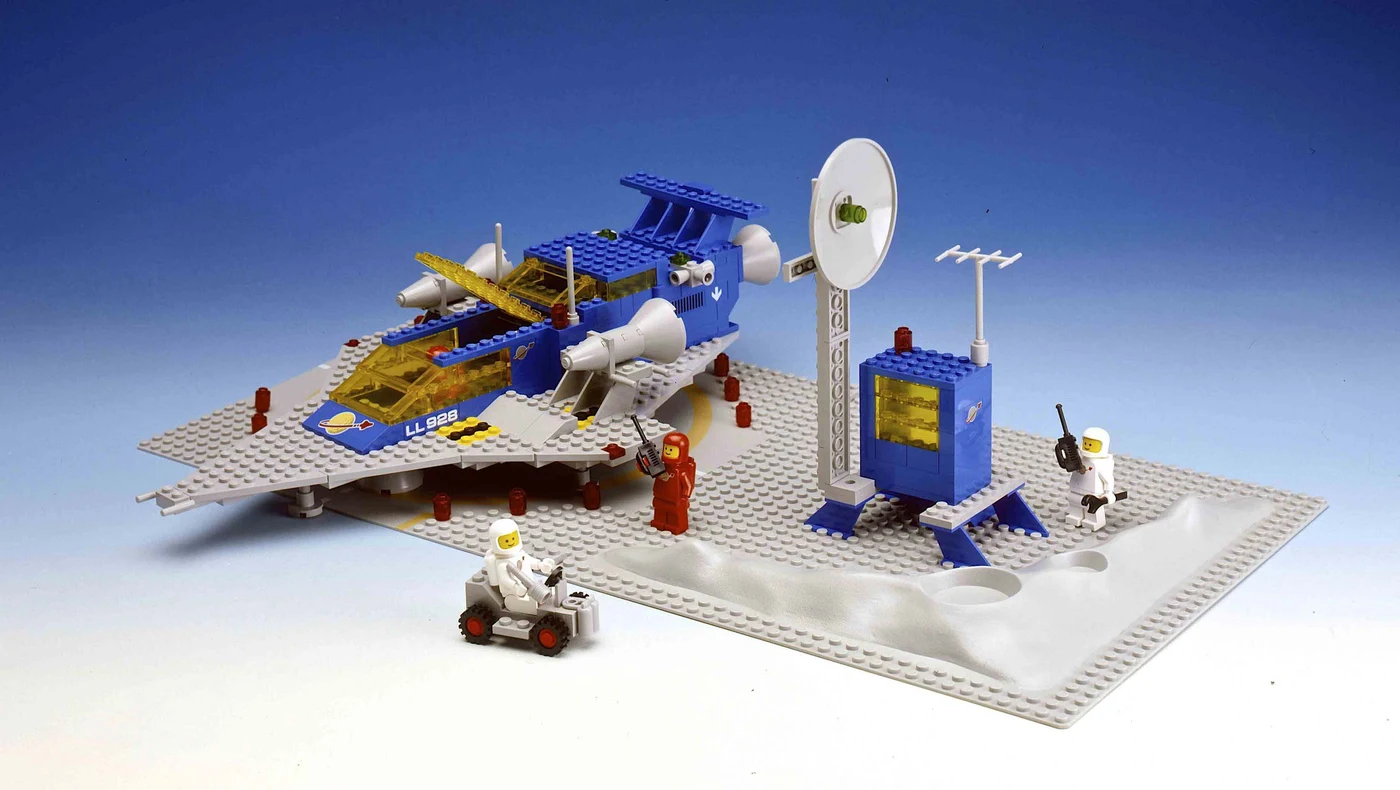
A good toy spaceship needs somewhere to land. It can be a printed baseplate, a cleared patch of carpet or the top of a remarkably convenient mountain made from a cushion. LEGO Space made that destination feel as interesting as the journey. Its little astronauts arrived with vehicles, equipment and the unmistakable suggestion that there was work to do.
The LEGO Group dates the Space theme to 1978, alongside the arrival of its familiar minifigure. Early spacecraft and bases drew on the space technology of the preceding decades. Blue and gray construction, transparent yellow windows, dishes and antennas established an immediately recognizable vocabulary. The 1979 Galaxy Explorer became one of the theme’s defining designs.
A future with a front door
Look at the historical photograph. The ship has a generous wing shape and a bright cockpit, but it does not float alone against a dramatic explosion. It sits beside a landing area, a small wheeled vehicle and equipment that looks ready to receive it. The scene is legible as a destination. Someone can get out, inspect something, and decide where to go next.
That changes the scale of the fantasy. The player can fly across the room, then return to the small business of parking and unloading. A landing becomes an event with several steps. This is an appealing rhythm for an imagined expedition: a grand journey punctuated by manageable jobs. Even the most distant planet benefits from a place to leave the vehicle.

The astronaut is equally direct. Two eyes, a smile, a helmet and the little orbiting-spacecraft emblem establish a person and an occupation. LEGO’s history notes that the first suits were red and white, with other colors arriving later. The helmet design also had to serve figures in other play themes. A practical production constraint became part of a particularly memorable silhouette.
A catalog planet
The 1983 Sears Wish Book stages a broader expedition on printed page 509. Space vehicles and bases occupy a rugged gray landscape across the top of the page. Among the pictured products are the Galaxy Commander, Starfleet Voyager and Beta-1 Command Base. This is a later selection than the 1979 Galaxy Explorer; the names and years matter when revisiting a favorite catalog picture.
The scenery does useful imaginative work. It joins separately numbered sets into what looks like one settlement. A buyer might choose one small vehicle, but the photograph supplies routes, neighbors and a destination for it. The scene quietly invites an extension beyond the purchase: another landing pad, another station, another stretch of terrain built from whatever is already available.
Below the space scene, Sears places ordinary town buildings and vehicles. The contrast makes the construction system visible. A fire station and an off-world base perform different jobs, yet both are places a little figure can inhabit. The catalog does not need to explain a theory of world-building. It demonstrates the idea by putting two working worlds on the same sheet.
The ship grows up
In 2022, LEGO revisited the Galaxy Explorer as set 10497 for its ninetieth anniversary. The newer model enlarged the original idea and added an interior with beds, computers and storage, plus a retractable ramp for its rover. Those details belong to the modern set, not the 1979 model shown here. Its appeal still rests on the same combination: a striking ship and a convincing everyday life aboard it.
LEGO later invited fan builders to reinterpret the 2022 ship through themes including plants, music and steampunk. That exercise makes a useful point about an enduring design. Recognition does not depend on freezing every piece in its original place. A familiar shape can survive quite a substantial change of purpose.
Perhaps that is why a building toy fits a wish list so well. The picture presents a finished object, but the contents offer many possible unfinished afternoons. A missing launch tower can become tomorrow’s project. A rover can grow another axle. The ship on the page is a destination worth reaching, and then a very good place to start again.