
VIDEO GAMES / GAMECUBE · After dark
One More Room: The Friendly Fright of Luigi’s Mansion
A nervous hero, a flashlight, and a vacuum cleaner made a haunted house feel worth exploring.

Luigi looks as though he would rather be somewhere else. That is a wonderful place to begin a haunted-house game. The player may want to explore, but the person doing the exploring does not greet every new room with effortless confidence. His unease gives the house its scale: even a doorway can feel like a decision.
The original Luigi’s Mansion accompanied the GameCube’s Japanese launch in September 2001. Nintendo’s European page gives a May 3, 2002 release for that region. Those dates belong to the same game reaching different markets, rather than to separate adventures. This story follows the original GameCube house, before the later sequels and handheld remake.
The equipment is wonderfully ordinary
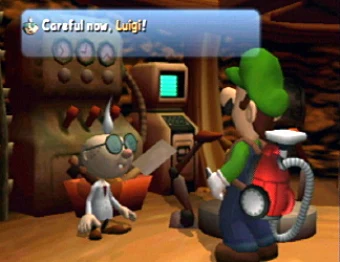
Nintendo’s description puts the task plainly: find the missing Mario, explore the mansion and solve its puzzles. Professor E. Gadd supplies a modified Game Boy and the Poltergust 3000. A flashlight stuns a ghost; the vacuum catches it; the struggling ghost has to be pulled against. The encounter turns a domestic appliance into a remarkably expressive game mechanic.
The joke begins with the tool itself. A vacuum cleaner belongs to the everyday work of keeping a house in order. Give it a tank, a hose and a nervous operator, then ask it to deal with the occupants. The absurdity provides relief without removing the tension of trying to get the task right.
It also gives the action a direction. A flashlight points toward something; a hose draws something back. On the screen, those two ideas are easy to read. Instead of treating a ghost as a distant target, the scene becomes a contest over the space between Luigi and whatever he has disturbed.
A room asks for attention
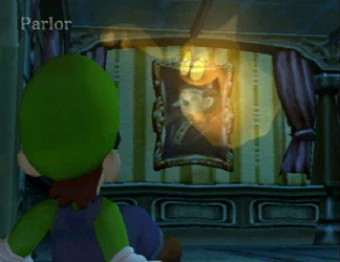
The Parlor screenshot has the intimacy of a little stage. Luigi’s head and cap occupy the near foreground, while the framed image waits across the room. The furniture holds the eye in place. You are encouraged to look into a bounded space, with enough detail to make it feel occupied even before anything moves.
That contained scale changes the pleasure of exploration. A room can be learned. Its arrangement becomes familiar, and a familiar arrangement makes an unexpected detail more noticeable. The desire to understand the place can become stronger than the desire to hurry through it. A haunted house works especially well when curiosity keeps reopening the door.
The promotional artwork and the screenshots make a useful pair. The first gathers the personality into one bold composition: green cap, worried face, colorful ghosts. The second shows how that promise fits inside a playable room. One invites you into the game; the other gives you a place to look once you have arrived.
The version that stayed an experiment
In a later Iwata Asks interview about Nintendo 3DS hardware, Hideki Konno recalled experimenting with glasses-free 3D using Luigi’s Mansion after the original game was completed. The test used a small LCD connected to the GameCube. Satoru Iwata noted that this version was never released. It is an intriguing development detour, rather than a feature of the GameCube copy players brought home.
The experiment is easy to understand when looking at the house. Foreground objects, doorways and the far wall already suggest layers of depth. A room invites the eye to measure distances. The appeal here is an observation about the imagery, not a claim that the original retail game secretly offered a 3D mode.
Courage can be comic
Later development interviews give another view of the series’ priorities. Discussing Luigi’s Mansion 2, the team described conversations about television and film scenes, empathy, and how an audience responds to events. Those recollections concern the sequel. They nevertheless provide a useful companion to the original’s visible strength: the player is watching a character react, as well as directing his actions.
A nervous hero can make bravery look like a sequence of small decisions. He does not have to stop being afraid before going through the door. The humor lets apprehension remain in the scene while making it bearable. A startled expression can be funny and sympathetic at once.
For an October evening, that combination is enough. The next room promises another little arrangement to examine, another disturbance to understand, and another chance to get the equipment working. Luigi may not be eager to continue. The player can still find a reason to help him try.