
CARTOONS & CHARACTERS · Moon magic
Patlabor: Giant Robots With a Day Job
Patlabor makes its machines part of the city—and gives the people around them a working life.

A giant robot can announce a hero. It can also suggest a shift roster. Patlabor makes room for that second possibility: large machines as equipment, police work as an occupation, and a future city that still needs people to show up and do their jobs.
The official series introduction describes a near-future Tokyo where general-purpose humanoid working machines, called Labors, have become widespread. Their use creates new kinds of crime, and Special Vehicles Section 2 responds with police robots. The machines enter a social system rather than hovering outside it.
The city comes with the robot
That premise gives the mechanical designs a context. A police machine belongs to an organization. A working machine has a use beyond combat. Together they suggest a city with construction sites, procedures and people who understand equipment in different ways. The surrounding world becomes part of the attraction.
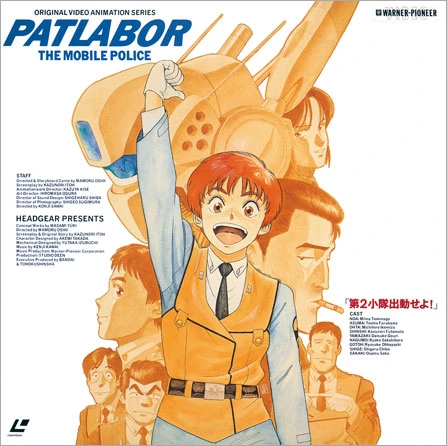
The project emerged from Headgear, a five-person creative group: Masami Yuki, Yutaka Izubuchi, Kazunori Ito, Akemi Takada and Mamoru Oshii. Its early original-video series and Yuki’s manga helped establish a world that could be explored in more than one medium. The official history emphasizes both the robots as a system and the characters’ everyday lives.
A film within a larger world
The first feature film reached Japanese cinemas on July 15, 1989. Production I.G’s record credits Oshii as director, Ito as screenwriter, Takada for character design and Kenji Kawai for music, with Headgear supplying the original story. Those names help locate the film within the larger collaboration.
The appeal of the premise does not require a robot to become ordinary in appearance. It can remain spectacular while its role makes sense. Equipment, an institution and a group of colleagues give the spectacle a place to belong. That is a useful distinction when so many mechanical heroes seem built only for the moment they arrive.
For a viewer drawn to miniature streets, model shops or the details of a machine, Patlabor offers a world to inspect. The question becomes less about how large a robot can be and more about what happens around it. Imagine the delivery, the storage space, the technician and the conversation after work. A working city makes room for all of them.
The workday is a powerful setting for a mechanical fantasy. A robot becomes more convincing when the world around it has responsibilities, habits and people with different jobs. Patlabor’s starting idea lets the machinery remain extraordinary while the lives around it feel recognizable.